
King Thrushbeard: The Lesson of Humility in Grimms Classic Tale

Introduction
Stories that end with a satisfying transformation—or a humbling, necessary defeat—have always been the gold standard of childhood literature. Rarely is this more vividly demonstrated than in the classic German tale, King Thrushbeard (or The Haughty Princess). This narrative, collected by the Brothers Grimm in 1812, is a masterclass in character study, a precise study of how pride, when raised to extremes, eventually collapses under the weight of its own haughtiness. It’s a story about the dangers of looking down on the “poor” and the unexpected wisdom hidden in the most humble guise. If your child loves tales where appearance hides a truth, or where a lesson is learned through a series of dramatic mishaps, King Thrushbeard offers a richly layered journey into the heart of virtue and the sharp, sharp edges of hubris.
The Anatomy of Hubris: The Princess’s Initial Pride

Before we meet the enigmatic King Thrushbeard, we must look at the catalyst: a beautiful, profoundly spoiled princess. This character sets the entire moral scale of the tale [1]. Unlike princesses found in later versions of fairy tales, this young royal views her designated suitors not with interest, but with a gaze of severe, rhyming judgment. The story opens with a parade of men arriving at the palace, each arranged by rank, but the princess treats them like a gallery of failed paintings.
Her insults are surprisingly detailed and brutally specific, setting a tone of sharp contempt. She rejects a tall suitor by noting he is “Thin and tall, no good at all” [2, 3], mocks a short man, calling him “Short and thick is never quick,” and dismisses a pale candidate as “As pale as death” [2, 3]. The most famous instance of her lack of empathy occurs when she encounters a wealthy king whose chin is even slightly asymmetrical. Pointing and laughing, she declares his chin “like a thrush’s beak” [2, 3]. This is the moment her title is cemented, turning the man into the future King Thrushbeard.
A Decree Born of Disdain
Exhausted and exasperated by her daughter’s vicious cruelty, the princess’s father issues a vow that acts as the story’s primary plot engine: the princess will marry the very first beggar who dares to cross the palace threshold [2, 3]. What the princess perceives as a final, comical insult for her father, is in fact the start of a rigorous trial of humility designed by fate.
King Thrushbeard: The Master of Disguise
Who, exactly, is King Thrushbeard? The brilliance of this tale lies in the shifting identity of the man. He is not a simple beggar, nor merely a hapless minstrel; he is a master manipulator and a shape-shifter, a figure who allows himself to be utterly dismissed before revealing his true, regal nature [1, 2, 3].
The first figure she marries is a wandering minstrel, or fiddler, who arrives seeking a handout [2, 3]. This initial marriage leads the pair through a magnificent setting—a vibrant green meadow, a vast forest, and a thriving town. As the princess observes the beauty of the land, she asks who owns it; the minstrel, always King Thrushbeard, responds that the land belongs to him. This leads to the princess’s first moment of doubt, a lament sung in regret: “Oh, I am a miserable thing; If only I’d taken the Thrushbeard King” [2, 3].
The Trials of Poverty: Humility Forged in Scars
To strip away her pride, King Thrushbeard puts the princess through a series of harsh domestic and professional failures. The initial phase of their journey into poverty is brutal: she attempts to weave baskets, but the willow fibers cut her delicate hands; when she tries spinning thread, her fingers bleed [1, 2, 3]. The trials continue as she enters the marketplace. Initially, she succeeds because the townspeople pity her beauty, but this fragile success is shattered when a drunken hussar (soldier) rides directly through her small collection of earthenware, smashing her meager wares to pieces [2, 3]. Utterly reduced to destitution, she finds herself working as a kitchen maid in a nearby castle, desperately trying to sustain her marriage by smuggling food scraps home in tiny jars fastened to her apron [1, 2, 3].
The Unveiling and The Lesson Learned
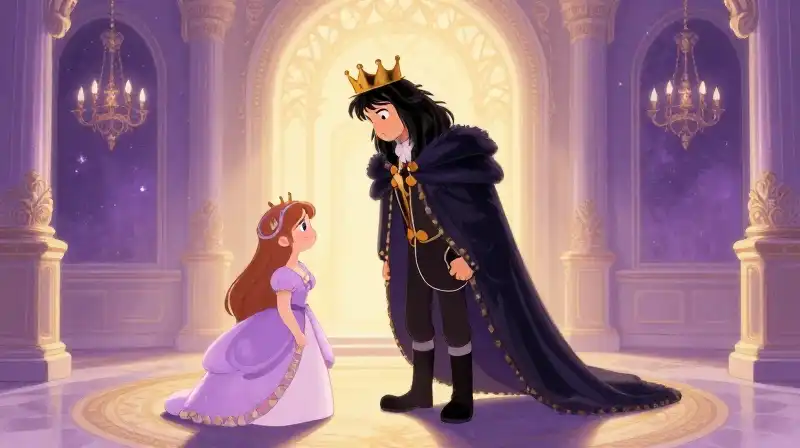
The dramatic climax arrives at a magnificent royal ball. Hidden in the shadows, the princess watches the opulence she no longer understands. When the king’s son forces her to dance, the fragile string holding her secret jars snaps. Left exposed, the leftover soup and food scraps spill all over the polished floor, attracting the uproarious laughter of the entire court [2, 3]. In that moment, the mask slips. King Thrushbeard reveals his true identities—first the minstrel she married, and then the drunken hussar who shattered her pots [1, 2, 3].
His reasoning is not simply malice, but profound instruction. Thrushbeard tells the mortified princess that his various cruel disguises and acts of mockery were specifically designed “to humble your proud spirit, and to punish you for the insolence with which you mocked me” [2, 3]. The princess finally breaks, tearfully admitting she was wrong and unworthy. Her long-held pride has been shattered, replaced by a hard-earned humility [1, 2].
King Thrushbeard in the Modern Imagination
This classic tale has proven endlessly adaptable across media, demonstrating its powerful, timeless theme. It is a story that has been retold countless times to suit various audiences and cultural tastes [1].
- Classic Retellings: The narrative has appeared in films, such as Herbert B. Fredersdorf’s 1954 German live-action production, and the 1969 Soviet animated short, The Capricious Princess [1].
- Educational Variations: Modern adaptations like *Grimm’s Fairy Tale Classics* retitle the princess as Elena, while *Simsala Grimm* names the royal couple Constance and Conrad [1]. These shifts in naming help tailor the story for contemporary classroom use.
- Contemporary Fantasy: The character’s archetype has expanded into modern literary worlds. King Thrushbeard has appeared as a resident of the Fabletown community in Bill Willingham’s *Fables* comic book series, and versions of the story are adapted in fantasy novels, such as David Drake’s *Servant of the Dragon* [1].
Answering the Burning Questions: Meaning and Narrative
What is the story of King Thrushbeard?
The story of King Thrushbeard is a journey of enforced poverty and public humiliation. It follows a highly arrogant princess who dismisses all suitors, leading her father to decree she marry a beggar. She eventually marries a master shape-shifter (Thrushbeard), who tests her with various trials—labor, poverty, public failure. The story concludes when her shame is exposed at a royal ball, leading to her realization and acceptance of her own unworthiness [1, 2, 3].
What is the meaning of King Thrushbeard?
The meaning of the tale transcends its plot. King Thrushbeard is the embodiment of a divine, transformative wisdom. He acts as a moral mirror for the princess. His meaning is not to be a villain in the conventional sense, but a “teacher” who uses humiliation as a pedagogical tool. The story teaches the powerful lesson that genuine worth is not determined by lineage or wealth (like the prince she should have chosen), but by character, humility, and how one reacts when they are stripped of their perceived advantages [2, 3].
Synthesizing the Wisdom of the Tale
King Thrushbeard is one of the most profound tales of social leveling in the Grimm collection. It challenges the notion that only the magnificent, gold-clad figures merit our attention. The journey from a haughty courtier to a kitchen maid, and from a beggar to a King, is an accessible, vivid illustration of moral growth. For parents and educators, the story provides rich thematic material for discussions on empathy, appearance versus reality, and the importance of looking beyond social standing. By the time the final scraps of soup spill on the floor, the princess has not just met a powerful King; she has fundamentally changed her perception of self and others.
Sources
- King Thrushbeard — en.wikipedia.org
- Grimm 052: King Thrushbeard — sites.pitt.edu
- King Thrushbeard — grimmstories.com
Frequently Asked Questions
What is the story of King Thrushbeard?
The story follows a highly arrogant princess who dismisses all suitor candidates, leading her father to decree that she must marry the first beggar to cross the threshold. She eventually marries a master shape-shifter named Thrushbeard, who subjects her to trials of labor and poverty. The tale concludes with her shame being exposed at a royal ball, resulting in her realization and acceptance of her own unworthiness.
What is the meaning of King Thrushbeard?
King Thrushbeard serves as the embodiment of a divine, transformative wisdom, acting as a moral mirror for the princess. His primary role is that of a teacher who uses humiliation as a pedagogical tool to help her grow. The story teaches that genuine worth is defined by character and humility, not by lineage or wealth.
Related Articles