

Why Benjamin Bunny Is the Ultimate Classic Bedtime Story


Introduction
When a children’s story feels truly perfect for bedtime, it doesn’t just happen. It requires a delicate balance—a rhythm that lulls the child toward sleep while still providing enough wonder, resolution, and emotional honesty to feel earned. *The Tale of Benjamin Bunny*, by Beatrix Potter, achieves this balance with remarkable precision [1]. It is far more than a simple bunny adventure; it is a masterpiece of gentle worldbuilding and character nuance, offering parents and educators a deeply enriching read. This analysis explores why Benjamin Bunny remains a staple in children’s literature, focusing on the quiet power of its themes, the soothing quality of its setting, and the nuanced portrayal of discipline that resonates long after the last page is turned [1].
The Perfect Blend: Mischief Meets Boundaries
 At its heart, *The Tale of Benjamin Bunny* operates in the tension between impulse and consequence. Benjamin and Peter, driven by innocent curiosity and the desire for the sweet bounty of Mr. McGregor’s garden, inevitably invite trouble [1]. Their initial adventure—the precarious entry where Benjamin explains that “the proper way to get in is to climb down a pear-tree” [1]—is a beautiful illustration of youthful daring. However, the story doesn’s shy away from the necessary structures of childhood. The narrative features a strong, if gently handled, undertone of paternal discipline, embodied by Old Mr. Benjamin Bunny [1].
Discipline as a Form of Love and Structure
One of the most insightful elements of this classic is how it frames the lessons of boundaries. The conflict escalates sharply when the rabbits are forced to hide for a prolonged period, waiting for a lurking cat to observe them [1]. This dramatic, drawn-out encounter requires a high degree of caution, heightening the stakes from simple mischief to genuine survival. The ultimate resolution—Old Mr. Bunny’s assertive, yet protective, return—shows a powerful transition from the thrill of the illicit to the necessity of order [1]. The eventual administrative “whipping” administered by Old Mr. Bunny, after the successful rescue, is a nuanced portrayal of parental discipline [1]. It is presented not as purely punitive, but as a necessary corrective action that reaffirms the boundaries of home and responsibility [1]. For children, seeing both the excitement of the transgression and the gentle, loving structure that follows offers a comforting template: boundaries are there for protection, not just punishment.
The Comfort of the Garden: Sensory Worldbuilding
The setting of Mr. McGregor’s garden is not merely a backdrop; it is a character unto itself. Potter builds a highly textured “worldbuilding” space, filled with specific, evocative details that anchor the fantastical adventure in something tangible [1]. The atmosphere provided by these sensory details is crucial for its suitability as a calming bedtime story.
Grounding the Fantasy in Practical Sensory Detail
Imagine the story’s landscape: the vibrant lettuce beds, the organized rabbit holes, and the framed flower-pots where the rabbits navigate their adventures [1]. These are not vague, fantastical spaces; they are meticulously realized environments. The sensory elements are designed to be absorbed easily by a young listener, transporting them from their own bedroom to a cozy, detailed world [1]. The practical sensory details—such as the sweet taste of lettuce, the sharp smell of onions, and the distinct “pitter-patter” of mortar falling [1]—serve a dual purpose. They engage the child’s imagination while grounding the story in relatable, physical experiences. This technique allows the imagination to roam (to the garden) while the narrative remains firmly rooted in the concrete (the scent of onions), creating a sense of secure, imaginative peace.
Character Nuance: Beyond the Mischief
 While Benjamin and Peter are certainly prone to mischief, reducing them merely to “troublemakers” misses the profound sympathy Potter builds for them [1]. The narrative subtly shifts the focus from their bad behavior to the external forces and unfortunate circumstances that affect them.
The Victims of Circumstance
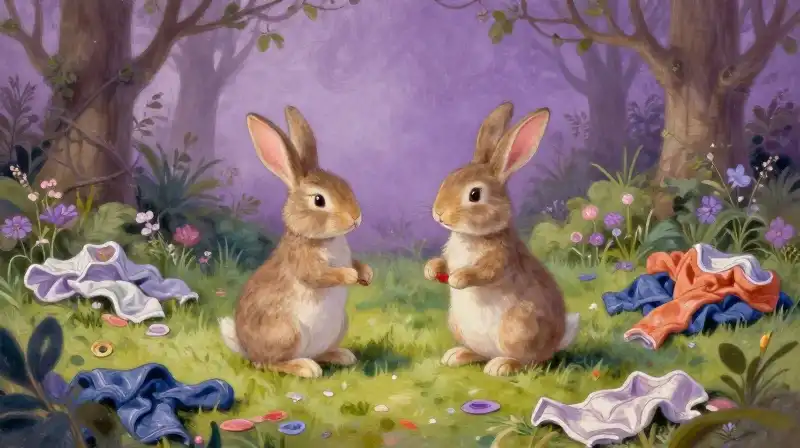
The subplot concerning the missing “Peter’s clothes” and the involvement of the scarecrow adds a sophisticated layer to the characters [1]. This detail shows the rabbits are not simply willfully defiant, but are victims of external circumstances—a gentle reminder that life and adventure often involve forces outside of their control. Their journey to find “Peter’s clothes” underscores their loyalty and their motivation, elevating them beyond simple pranks into relatable, adventurous figures [1].
Finding Resolution Through Shared Reward
The conclusion provides a genuinely comforting and satisfying resolution that is perfect for ending the night. After the drama and the subsequent discipline, the rewards of their day are not simply forgotten. The stolen onions, hard-earned and preserved, are hung for future use [1]. This final act symbolizes the successful completion of the adventure—the value of the experience, even if it led to a warning, is preserved and cherished [1].
Benjamin Bunny as a Bedtime Guide: Practical Reading Tips
For parents and educators seeking a specific type of story, *The Tale of Benjamin Bunny* offers a unique blend of action and soothing rhythm.
- Rhythmic and Soothing Language: The prose uses clear, warm, and imaginative analysis, making it highly accessible for both young children and older readers alike.
- Age Appropriateness: While the conflict includes a predatory creature (the cat) and a scene of discipline, the overall tone maintains a comforting resolution. The dramatic moments are contained within a safe, well-defined environment (the garden), allowing parents to read it as a tale of gentle challenge and growth [1].
- The Power of Detail: This story is excellent for teaching children how to observe the world. By noticing “rabbit holes,” lettuce beds, and framed flower-pots [1], children are subtly encouraged to develop their observational skills in their own environment.
Addressing Common Reader Questions
Is Benjamin Bunny scary for preschoolers?
While the story features a predatory cat and a scene of discipline, the threat is managed and resolved by the protective presence of Old Mr. Benjamin Bunny [1]. The suspense is built through a controlled, contained conflict (hiding in the garden) rather than through open horror. The ultimate theme of safe resolution—the father’s protection and the rewards found—offers significant emotional security, making it generally suitable for a range of young listeners seeking a tale with high-stakes, but ultimately comforting, stakes [1].
What makes this rabbit community unique?
The rabbit community is rich and functional. Old Mrs. Rabbit provides a strong element of domestic industry by maintaining a livelihood through knitting mittens and selling herbs and lavender [1]. This provides a grounded, productive counterbalance to the mischievous antics of Benjamin and Peter, showing the healthy coexistence of hard work and play in their world [1].
Synthesis: The Enduring Heart of a Classic Tale
*The Tale of Benjamin Bunny* endures because it never simplifies. It is a story that honors childhood curiosity and inevitable mistakes while firmly establishing the protective and loving boundaries of home and family. It teaches children that even in moments of great fear—like hiding for five hours while a cat observes them [1]—and even when discipline is required—the ultimate reward is finding safety, family, and the sweetness of preserved joy [1]. This blend of vivid, sensory worldbuilding, nuanced character motivation, and a genuinely comforting structure is precisely what makes Benjamin Bunny the perfect narrative bridge between the wildest moments of a child’s day and the quiet peace of bedtime.
Sources
- The Tale of Benjamin Bunny - Short Kid Stories — shortkidstories.com
Related Articles