
From Puppet to Boy: The Lessons of the Pinocchio Fairy Tale

Introduction
There are stories that simply entertain, and then there are stories that act as a moral blueprint for the human heart. Carlo Collodi’s *The Adventures of Pinocchio* belongs firmly in the latter category. More than just a whimsical tale of a wooden puppet, it serves as one of literature’s most profound and enduring explorations of how we move from being merely things—puppets, tools, objects—to becoming beings of true substance. Pinocchio’s journey is not a sudden magical transformation; it is a long, often painful, and deeply honest process of becoming.
For parents and educators, the tale offers far more than a catchy plot—it provides a rich tapestry of psychological archetypes and moral stakes. It invites us to look closely at the characters who tempt, guide, and judge him, and to understand that the central question of the book is not “How does Pinocchio become a boy?” but “What does it truly mean to be a good man?” This is the story of diligence, conscience, and the enduring power of sacrificial love.
Answering the Big Question: What is the Story of Pinocchio?
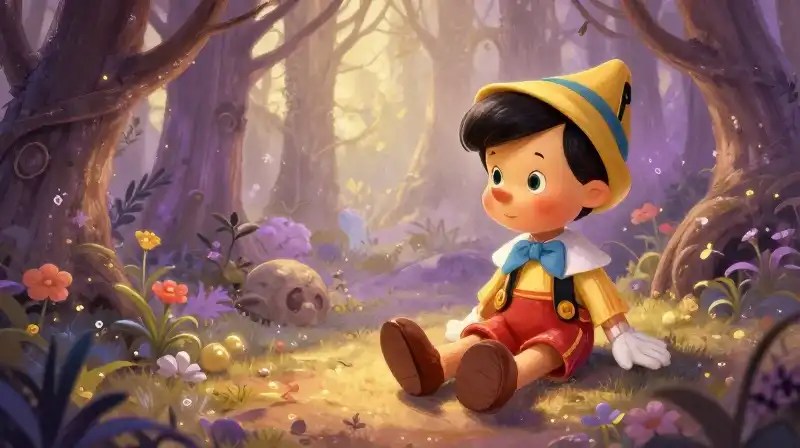
At its core, *The Adventures of Pinocchio* tells the story of a wooden marionette who yearns to transcend his crafted existence. Pinocchio is brought to life by the diligent hands of Geppetto, a humble clockmaker, who wishes for a son [1]. The puppet is given a profound desire: to become a “real boy” [1, 2]. Because of this yearning, the Blue Fairy intervenes, guiding him on a treacherous path defined by trials, temptations, and lessons. The narrative chronicles Pinocchio’s initial disobedience—a willingness to choose immediate, selfish pleasure over long-term growth [1, 2]. His quest becomes a continuous search for moral truth, marked by the heavy consequences of his choices.
The Characters as Moral Archetypes
The beauty of Collodi’s story is that every creature and character embodies a specific, recognizable facet of moral development. They are not just obstacles; they are teachers. Understanding their specific role helps us see the themes of the story more clearly.
- Geppetto: The Heart of Hope. Geppetto is the embodiment of hopeful, protective, and parental love [1, 2]. He is the anchor of the story, driving the central quest with the sincere belief that his creation can achieve humanity. His love is unwavering, even when Pinocchio disappointingly fails him.
- The Talking Cricket: The Conscience. The Cricket acts as Pinocchio’s internal, literal voice of conscience [1, 2]. He is the constant, quiet reminder of the correct path, repeatedly warning the puppet against laziness and the dangers of his own impulsive actions [1, 2]. He embodies self-awareness.
- The Fox and the Cat: Temptation and Deceit. This antagonistic pair represent classic fairy tale archetypes, specializing in trickery [1, 2]. They don’t just physically threaten Pinocchio; they manipulate his deepest vulnerabilities, using deceit—such as feigning disability—to lead him down paths of greed and easy gain [1, 2]. They represent the immediate, alluring lie.
- The Blue Fairy: The Moral Arbiter. The Blue Fairy provides the framework for redemption [2]. She is the ultimate judge, offering repeated chances for Pinocchio to grow, but only if he demonstrates genuine bravery and proves his intrinsic worth, not just his wooden construction [2].
The High Cost of Deceit: A Visual Consequence
Perhaps the most visceral element of the story is the physical manifestation of Pinocchio’s moral failings. The most famous symbol is his nose [1, 2]. When he lies, the nose grows. This is not a punishment; it is a immediate, concrete, and undeniable visual consequence of his untruth. This brilliant piece of literary design allows young readers to understand that lying has a tangible, observable impact. His failure to prioritize his goals—such as selling his valuable school books for a momentary distraction at the Marionette Theatre [1, 2]—is not just a plot point; it is a miniature lesson in prioritizing lasting virtue over fleeting amusement.
The Symbolism of the World: Caution and Redemption

The various settings and characters Pinocchio encounters serve as potent symbols that explain the stakes of his transformation. These locations are mini-lessons in human behavior.
| Setting or Creature | Symbolism/Meaning | The Lesson Learned |
|---|---|---|
| Pleasure Island | Unchecked Indulgence/Excess | The excessive candy and play lead Pinocchio to transform into donkeys, symbolizing the utter abandonment of diligence and work [2]. |
| The Owl and The Crow | Unreliable Judgment | These observers, who make absurd claims (one claiming to be alive, the other dead), highlight the need for Pinocchio to rely on his own conscience rather than the opinions of others [1]. |
| The Marionette Theatre | Momentary Gratification | Choosing the ticket over his studies shows his initial willingness to sacrifice long-term goals for instant, shallow pleasure [1, 2]. |
The Theme of Sacrifice: Moving Beyond Magic
The transition from “puppet” to “boy” is frequently oversimplified as a sudden act of magic. However, the narrative makes it clear that magic alone is insufficient [1]. Pinocchio’s ultimate transformation requires a deep investment of moral will, diligence in his studies, and most crucially, the willingness to sacrifice. When he sacrifices his hard-earned savings to help the Blue Fairy, he proves his commitment to a higher purpose—not just to himself, but to the pursuit of goodness [1]. This teaches readers that genuine growth is often messy, expensive, and requires putting another’s needs before one’s own desire for easy reward.
Why Does Pinocchio Matter for Children and Parents? (Addressing PAA)
Parents often wonder how to discuss complex moral issues with young children in a way that feels meaningful rather than didactic. The Pinocchio story offers a framework for this conversation.
Instead of just telling a child, “Don’t lie,” the tale provides a vivid, visual example of what untruth *does* to Pinocchio. The growing nose [1, 2] provides a concrete, relatable image of consequences. Furthermore, the duality of his temptations—from the deceit of the Fox and Cat to the mindless excess of Pleasure Island [2]—gives children multiple entry points for discussion: discussing integrity, the value of hard work, and the difference between fun and responsible play.
By studying Pinocchio, children learn that they are not born perfect, and that the “real boy” inside them is a work in progress, built through consistent choices and moral effort. His journey normalizes the struggle—it shows that second chances are possible, but they require effort [2].
Diving Deeper: What makes Pinocchio remarkable?
Pinocchio’s enduring power lies in his complete lack of inherent perfection. He is “incomplete,” just as he starts as a wooden object. This imperfection is what allows for growth. The Blue Fairy grants him opportunities for redemption, not because he is fundamentally good, but because he is willing to fight for goodness. His eventual achievement is a victory of character over condition [2]. He moves from being a passive, artificial object to an active agent of his own moral destiny.
Ultimately, the Pinocchio fairy tale is a beautiful and rigorous lesson in agency. It shows us that while we may start as anything—a puppet, a fledgling, a blank page—we retain the power, through the quiet choices of the heart, to write our own story of meaning and depth.
Sources
- The Adventures of Pinocchio — en.wikipedia.org
- World Stories Bank — worldstoriesbank.org
Frequently Asked Questions
What is the story of the fairy tale Pinocchio?
At its core, the tale tells of a wooden marionette brought to life by the diligent clockmaker Geppetto who wishes for a son. Pinocchio is given a profound desire to become a "real boy" and is guided on a treacherous path of trials and temptations. His journey chronicles a continuous search for moral truth, marked by the heavy consequences of his choices.
Related Articles