
Little Red Riding Hood: Symbolism, Origin, and the Grimm Story Explained

Introduction
The vibrant hue of a velvet cap, the brilliant red of a ribbon, the fleeting crimson of a wild berry—color holds deep secrets in children’s literature. When we think of Little Red Riding Hood, we think of this distinctive color, yet the red in her cap is far more than a costume detail. It is a concentrated motif, representing both the intense innocence of childhood and the bright, almost siren-like draw of the unknown. This seemingly simple character, originating from the collection of the Brothers Grimm, is a masterpiece of cautionary storytelling, yet she invites far deeper exploration than merely being a “good girl who must obey.” She is a bridge between the safety of the hearth and the deep, enchanted mystery of the wood, a journey that sparks vital conversations about curiosity, warning, and the necessary dangers of life.
Little Red Cap: An Analysis of the Character
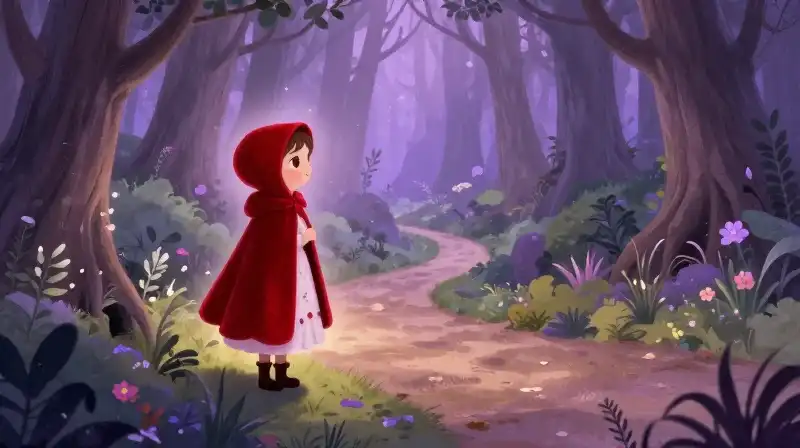 The figure known as Little Red Cap (or Little Red Riding Hood, depending on the adaptation) serves as a visual embodiment of a specific tension. Her defining feature—the “little velvet cap, dyed red”—is not merely fashionable; it is a potent symbol. The red signifies her status as an innocent child, yet it is also the color of life, of vital blood, and of the seductive lure that draws one toward great danger. Throughout the narrative, Little Red Cap is defined by her internal struggle. Her journey begins with a simple, practical mission: carrying provisions for her grandmother. This task is predicated on a fundamental instruction from her mother: “do not leave the path” [1, 2, 3]. The path represents order, safety, and the bounds of domestic life. When she deviates from this prescribed route to pick flowers, she is performing an act of pure, unadulterated exploration. This deviation links her directly to her vulnerability. The predatory nature of the surrounding world, embodied by the wolf, is immediately apparent. The wolf, who functions as the classic cautionary villain, does not simply attack; he manipulates. He is a creature of cunning, relying on flattery and psychological warfare, flattering her as if she were a local, school-going child [1, 2]. Little Red Cap’s own innocence is demonstrated by her lack of perception. Her engagement in the “dialogue of misidentification”—asking about the wolf’s enlarged ears, eyes, hands, and mouth—shows her inability to see the hidden nature of the predator even as the danger closes in [1, 2, 3]. She sees only the magnificent, monstrous truth, not the common threat.
The Psychological Landscape of the Forest
The setting of the story is critical to its meaning. The forest, in the Grimm tradition, is rarely depicted as a uniform, dark, fearful wasteland. Instead, the source material often describes it with breathtaking, albeit deceptive, beauty—complete with “sunbeams dancing” and “beautiful flowers” [1, 2]. This aesthetic beauty is a psychological contrast. The enchantment and “perfection” of nature exist alongside the hidden, wicked predator lurking within its trees. This suggests that the danger is not external to the world—a monster from another dimension—but is inherent *in* the world, camouflaged by its allure. For a child, this means that even the most beautiful things require a careful level of observation and an understanding of hidden truths.
Comparing Story Versions: The Two Endings
 Because this tale has traveled across borders and centuries, its endings and structural nuances vary, often emphasizing different lessons. Understanding these versions helps us grasp the full thematic breadth of the folklore. The source material presents two distinct resolutions to the central conflict, each offering a different cultural perspective on how to address an external, predatory threat:
| Version | Resolution Method | Thematic Emphasis | Cultural Origin |
|---|---|---|---|
| Huntsman Intervention | A huntsman finds the wolf, cuts open its belly, and fills it with stones. | External Authority; the necessary intervention of societal protection to restore order. | ”Traditional” Grimm version [1, 2, 3] |
| Grandmother’s Trap | The grandmother employs a resourceful, domestic defense—using boiled sausage water to trap the wolf in a stone trough. | Internal Agency; the wisdom of the home as a sanctuary and the proactive cleverness of the vulnerable. | Later addition by Marie Hassenpflug [1, 2, 3] |
| The contrast between these endings is significant. The huntsman represents a sweeping, external force of justice that cleanses the world. The grandmother’s use of domestic tools (sausage, trough) to defeat the predator turning the home into a literal fortress against the wilderness, emphasizing the resilience and intelligence of the community rather than just the intervention of a singular figure [2, 3]. |
The Symbolic Weight of the Red Cap and the Path
To answer the question, “What does Little Red Cap symbolize?”, one must look at the dual meaning of her journey. She symbolizes the transition from the sheltered world of the home (the path) into the unpredictable, sensory-rich expanse of the outside world (the woods). Her “red cap” represents the vibrancy of life and the unique, captivating nature of youth, which is both a source of joy and a target for those who recognize the delicious power of innocence. The constant reminder is the principle of adherence to boundaries. The final concluding episode, added by Marie Hassenpflug, drives this home with an explicit moral: the protagonist “will never leave the path and run off into the woods by myself if mother tells me not to” [1, 2, 3]. This is the ultimate lesson: exploration is vital, but it must be framed by wisdom, boundaries, and awareness.
Addressing the Little Red Cap and the Brothers Grimm
A common query arises regarding the origin and attribution of the tale. To clarify, while the story is commonly known today as Little Red Riding Hood, its roots are found in earlier folk sources, notably attributed to Jeanette Hassenpflug in 1791–1860. The Brothers Grimm preserved and published the tale in their collected works, *Kinder-und Hausmärchen*, in 1812, which established its enduring historical place in European folklore [1, 3]. The differences in English translations, such as the adoption of “Little Red Cap,” reflect the varying traditions of adaptation and popular retelling, shifting the focus slightly from a generic girl to a character defined by her vibrant attire [1, 2].
Navigating the Lesson: Caution vs. Education for the Child
As a parent or educator, you may ask: is this tale meant to instill fear? The narrative’s “scary” elements—the wolf’s deception, the threats—are carefully balanced against the story’s underlying beauty (the sunbeams, the flowers). The wolf’s menace comes from his manipulative cleverness, not just his brute strength. The tale is less about primal fear and more about developed awareness. For bedtime, this story is excellent for a deeper discussion:
- On Boundary Setting: Use the theme of the path to discuss personal safety rules and the importance of listening to trusted voices.
- On Perception: Discuss how appearances can be deceiving, just like the beautiful flowers that lead off the path.
- On Agency: Use the Grandmother’s trap as a model for creative problem-solving, showing that cleverness can often defeat brute force.
The tale teaches that while the world is a magnificent, wild place, it requires respectful interaction and a steady hand in guiding one’s own choices.
Synthesis: Why Little Red Cap Endures
Little Red Cap endures because she is a perfect allegory for the delicate balance between childhood curiosity and the need for adult wisdom. She is not merely a victim, but a representation of vibrant, living innocence that is, by virtue of its color and its spirit, noticed—and therefore, targeted. By examining the variations of the tale, we see that the answer to the question “Should we be afraid of the woods?” is not a simple yes or no. It is a reminder that true safety is found not only in boundaries, but also in the ability to see the truth behind the beauty, a lesson that remains timeless for every child who ventures past the doorstep.
Sources
- Grimm 26: Little Red Cap — sites.pitt.edu
- Little Red Riding Hood — grimmstories.com
- Little Red-Cap by The Brothers Grimm | Full Text — americanliterature.com
Frequently Asked Questions
Is Little Red Cap a Brothers Grimm story?
Yes, the Brothers Grimm preserved and published the tale in their collected works, *Kinder-und Hausmärchen*, in 1812. Although the character originated in earlier folk sources, the Brothers Grimm established the story's enduring historical place in European folklore through this publication.
What does the Little Red Cap symbolize?
The Little Red Cap symbolizes both the intense innocence of childhood and the vibrant, captivating nature of youth. Her character also represents the transition from the safety and order of the domestic home into the unpredictable and sensory-rich expanse of the outside world.
Related Articles