
Sleeping Beauty: Decoding the Enchantment, Curse, and Origins of the Tale

Introduction
The moment a hundred years pass and the castle creaks open, the scent of ancient magic is unmistakable. Sleeping Beauty is not just a story about a deep sleep; it is an intricate tapestry woven from motifs of prophecy, enforced stillness, and the enduring power of genuine affection. Across cultures, the myth of the cursed princess has served as a mirror for fear of fate and the hopeful arrival of destiny. For parents and educators exploring the depths of this classic narrative, understanding Sleeping Beauty means peeling back the layers of historical evolution, from Basile’s darker, more complex versions to the benevolent, comforting rhythms of the Aurora story familiar to children today. We invite you to look past the spinning wheel and the handsome prince to uncover the themes of magical entrapment, the brilliance of world-building, and how the stories find meaning in their shadows.
The Seed of the Curse: Unearthing the Origins
Before the famous courtly romances were written down, the seeds of the Sleeping Beauty motif were being sown across medieval Europe. This narrative did not spring forth fully formed; it evolved from earlier courtly tales and Provençal narratives like Fraire de Joi e sor de Plaser (c. 1320–1340) [1]. The structure of the story has changed dramatically over time, shifting from a dark cautionary tale involving complex betrayals to a more streamlined, rhythmic bedtime story focused on benevolent intervention.
The Spindle and the Prophecy
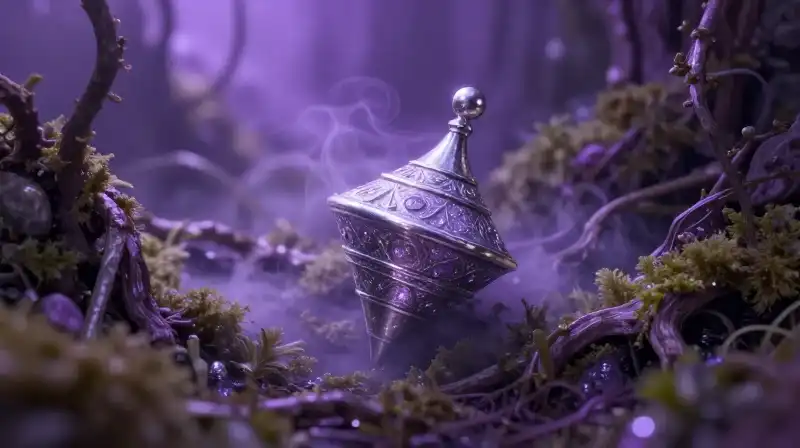
The central catalyst—the cursed object—has undergone a fascinating transformation. Early versions, such as Basile’s Sun, Moon, and Talia, depicted the princess receiving a painful injury when she pricks her finger on flax [1]. Later versions, including those by Perrault and the Brothers Grimm, solidified the iconic imagery: the curse is triggered by a spinning wheel spindle [1, 3]. This motif of the sharp, fateful needle—whether flax or wood—remains the definitive spark that initiates the protagonist’s enforced stasis.
A Tale of Shadows: Basile vs. Perrault
To truly appreciate the depth of this tale, it is helpful to compare its early forms. Basile’s version is far darker and more complex than the version we usually read to toddlers. While the more widely known tales emphasize destiny, Basile introduces intense human conflict [1].
- The Basile Narrative: This early version includes a complex moral landscape, featuring a second act where a queen plots murder against the princess and her twins, showcasing a darker, more turbulent social commentary [1].
- The Perrault Narrative: Perrault offers a more subtle and harmonious interpretation where the central themes focus on destiny and benevolent intervention. When the princess sleeps, the seven fairies work together to soften the curse instead of allowing death to claim her, setting the stage for a gradual awakening [1].
- The Grimm Narrative: The Grimm version, focusing on Rosamond, emphasizes the princess’s inherent goodness and grace. She is portrayed as lovely, sweet, and modest, fulfilling the wise women’s blessings [3].
Thematic Framework: Stasis, Love, and Time
Beyond the plot, Sleeping Beauty operates as a profound metaphor. The “sleeping” phase of the tale functions as a powerful symbol for enforced stasis—a life held in suspension, waiting for a catalyst [3]. This idea of being “hidden from view” is captured brilliantly in the narrative where the castle is concealed by an impenetrable hedge of thorns, a physical manifestation of the curse’s binding power [3].
The Power of the “True Love’s Kiss”
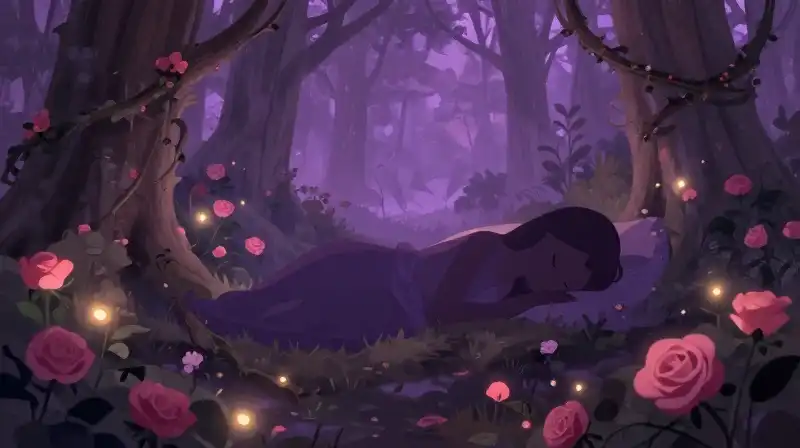
The awakening is always precipitated by a singular, decisive event: the “true love’s kiss” [2]. This element is a powerful literary device that allows themes of love and courage to overcome even the most formidable magical block [2]. The kiss doesn’t just wake her; it symbolically breaks the spell, moving the tale from a state of stagnant magic to one of forward motion and rebirth. This transition is visually depicted by the magical transformation of the environment: the lethal, impenetrable hedge of thorns eventually changes to a beautiful hedge of large flowers as the hundred years conclude [3].
The Contrast: The Enchanted World vs. The Cursed Kingdom
The story’s richness is found in its contrasting settings. There is a stark contrast between the grand, cursed palace—a place of silence and arrested time—and the vibrant “enchanted forest” or hidden woods [1, 2]. This dichotomy underscores the power of nature and benevolent forces (represented by the fairies and the woods) against the cold, static power of the curse and the villainous sorceress [1, 2]. The “hidden” setting is where the princess is guarded and where her eventual encounter with the prince takes place, marking the true turning point of the story [1, 2, 3].
Answering User Questions About Sleeping Beauty
Many readers and parents have questions when delving into the world of this timeless fairy tale. Here is a look at the origins and core elements of the story.
What fairy tale is Sleeping Beauty based on?
While the most recognizable version comes from French courtly tradition, the archetype of Sleeping Beauty is ancient, tracing its roots back to various Provençal narratives centuries ago [1]. The “French” version is what most people know, but the archetype itself is part of a vast European folklore tradition involving cursed princesses and restorative magic [1].
Decoding the Imagery: The Colors and Symbols
In children’s literature, symbols and colors help readers feel the weight of the story. Sleeping Beauty offers a potent palette to explore through illustration and interpretation:
| Symbol/Color | What It Represents | How to Use It (Art/Teaching) |
|---|---|---|
| Deep Blue/Grey | Stasis, The Curse, The Night | Use this to depict the “Sleeping” period—a sense of suspended, heavy silence or the magical darkness of the hedge of thorns. |
| Vibrant Green | The Enchanted Forest, Growth, Nature | Represent the living world that persists despite the curse; a color of hope and eventual rebirth when the hedge transforms into flowers. |
| Gold/Amber | Destiny, Magic, The Prophecy | Use this to highlight the royal elements, the blessing of the fairies, or the powerful magic of the spindle itself. |
| Soft Pink/Rose | True Love, Tenderness, Awakening | Connect this color to the “True Love’s Kiss” moment—the softening of the curse and the dawn of the new beginning. |
Why This Story Matters for Bedtime
For bedtime, Sleeping Beauty serves as a masterful lesson in the triumph of fate over misfortune, offering a deeply comforting narrative arc for children. The core themes are hope and eventual renewal, which are perfect for a winding down. The gradual transformation—the shift from lethal thorns to beautiful flowers [3]—provides a sensory and visual sense of peace, signaling the end of a long, dark period of worry and ushering in a soft, vibrant morning.
The Sleeping Beauty Motif as a Metaphor for Growth
While the story is romantic, its underlying message is incredibly practical for discussing life with children. The curse represents an obstacle—a period where growth or happiness is artificially withheld. The necessity of the prince (or the “true love”) is the ultimate external impetus required to break through the stagnation. This teaches children that while life might feel frozen or difficult sometimes, there is an “outside force”—be it self-love, kindness from others, or determination—that can always lead to a beautiful awakening.
Sleeping Beauty is remarkable because it is a story of powerful transitions. It moves us from the rigid boundaries of a cursed castle to the fluid, blooming beauty of the enchanted garden. It teaches that even the “darkest of curses” can be met with gentle love and intervention, transforming a scene of silent dread into one of enduring light and love [2].
Sources
- Sleeping Beauty — en.wikipedia.org
- Sleeping Beauty Story — readthetale.com
- Sleeping Beauty (Little Briar Rose) — grimmstories.com
Frequently Asked Questions
What fairy tale is Sleeping Beauty based on?
The archetype of Sleeping Beauty is ancient, tracing its roots back to various Provençal narratives from centuries ago. While the most recognizable version comes from French courtly tradition, the story itself is part of a vast European folklore tradition involving cursed princesses.
Related Articles