
The Evil Queen in Snow White: Unpacking the Icon of Cinematic Malice
Introduction
In the grand tapestry of children’s literature, few antagonists shine with the brilliant, polished malice of Disney’s Evil Queen. She is a figure of magnificent contradiction—a monarch defined by profound, destructive beauty. Her story is not merely one of a wicked person, but of an obsession that festers within the gilded cage of a royal life. When we look at the 1937 cinematic debut of Snow White and the Seven Dwarfs, we are viewing a crucial pivot point in storytelling: the moment classic European folklore was reimagined into the high-definition, iconic archetype we recognize today.
The Evolution of Malice: From Page to Silver Screen
 To truly appreciate the weight of the Evil Queen, we must first look at her lineage. The original inspiration for this character can be traced back to the 1812 German fairy tale *Schneewittchen*, penned by the Brothers Grimm [1, 2]. This early version establishes the foundational conflict: a beautiful princess facing the jealousy of a powerful female figure. However, the Queen we know from the classic 1937 film is a dramatically heightened, cinematic interpretation [1].
The Archetype Refined by Disney
Disney’s transformation elevates the character from a generalized fairy tale antagonist into a specific, visceral icon. The filmmakers took the core conflict of jealousy and rendered it through heightened visual design and intense personality. She is portrayed as a cold, sadistic, and utterly ruthless figure, whose life is governed by a singular, unwavering standard: remaining the “fairest in the land” [2]. This extreme vanity drives every decision, painting her not just as a jealous ruler, but as an inherently brittle one who fears the loss of control over her own image [2].
| Feature | Grimm’s Original Character (1812) | Disney’s Cinematic Icon (1937) |
|---|---|---|
| Core Motivation | Classic jealousy (implied) | Extreme vanity and obsession with beauty [2] |
| Primary Weapon | Implied malice | Dark magic and the poisoned apple [2] |
| Visual Design | Simpler folk archetype | A 1930s femme fatale blended with a medieval villainess [2] |
The Visual Language of Obsession: Design and Color
The visual design of the Evil Queen is a brilliant study in contrast, serving to emphasize the conflict between her internal rot and her outer regal authority [2]. The Queen embodies a sinister beauty that transcends typical cartoon caricature; her look was modeled after features of great icons like Greta Garbo, Joan Crawford, and Marlene Dietrich, making her appear both dangerous and alluring [2].
Regal Form, Monstrous Soul
Her aesthetic combines the high-collared elegance of medieval royalty with the dramatic flair of a modern villain. The use of dark, rich colors—deep purples, blacks, and shadows—contrasts sharply with Snow White’s bright, verdant wardrobe, making her presence feel heavy and suffocating [2]. Her domain, the Queen’s castle, is not just a residence; it is a symbol of her “domestic control and imperial power” [2]. Even the peacock motif on her throne speaks volumes, anchoring her status in vanity and splendor.
The Tools of Malice: Mirrors and Magic
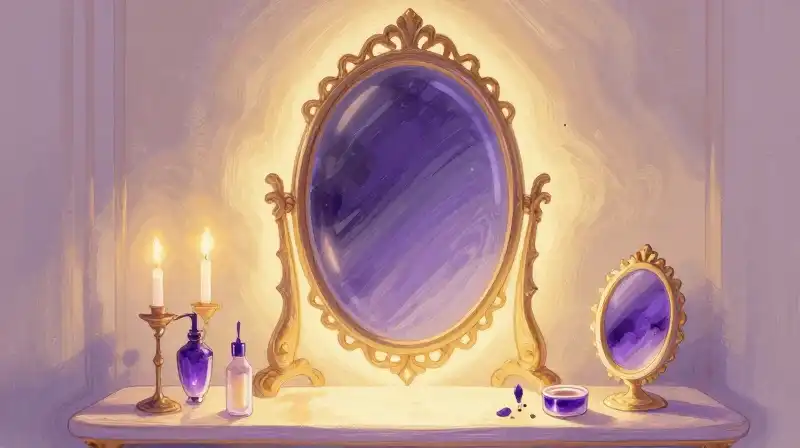
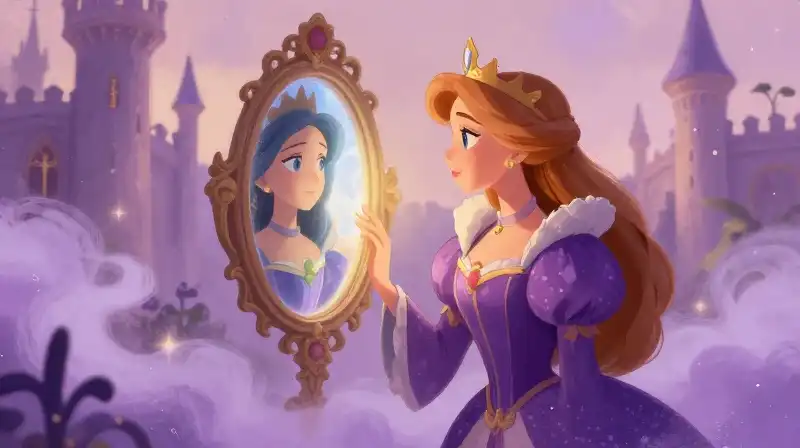
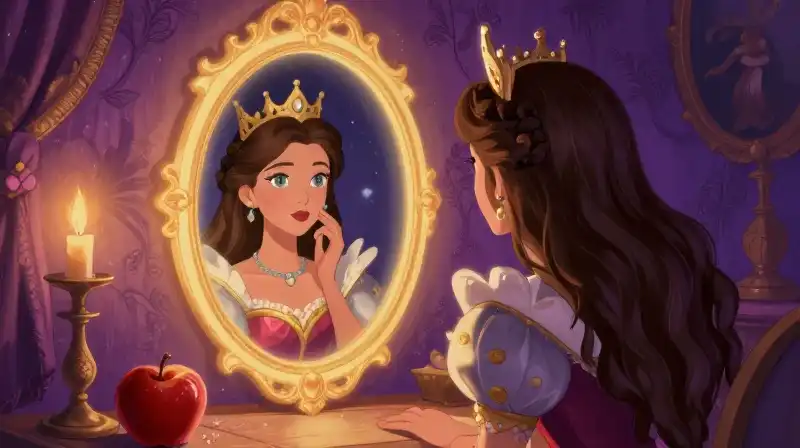 The Evil Queen’s primary tool is not brute strength, but a subtle, relentless form of psychological warfare. Her magic mirror serves as the central device of her obsession [2]. It is a window into her own insecurities, a constant, cold validator of her perceived perfection. When the mirror informs her of Snow White’s greater beauty, the magic transforms from a tool of vanity into a catalyst for destruction [2].
A Sophisticated Threat
The Queen’s methods of malice are remarkably sophisticated for a children’s tale. She does not merely shout or swing a sword; she uses manipulation and specialized, “dark” magic to induce “the Sleeping Death” via the infamous poisoned apple [2]. Concept artists found this challenging: how to depict a character who must be both regally beautiful and monstrous [2]. Her complexity—her inability to handle the simple, unrestrained happiness of Snow White—makes her a terrifying and “real and complex” figure [2].
Who Was the Original Evil Queen? What Happens in 1937?
We often wonder about the Queen’s roots and her ultimate fate.
The Roots: Brothers Grimm and Folklore
The character’s ancestor, the figure from *Schneewittchen*, embodies the “first antagonist in the animated features canon” [1] and the older folklore tradition. In the earlier fairy tales, the Evil Queen often represents the destructive power of unchecked jealousy and the social pressure placed upon women of status.
The 1937 Finale: A Story of Transformation
In the 1937 Disney version, the Evil Queen’s scheme is comprehensive. Driven by her fear of displacement, she orchestrates Snow White’s demise [2]. While the film depicts her lethal machinations, her final state—the transition of her power and the restoration of the natural order—reflect the cinematic arc of “evolution of folklore into iconic cinematic archetypes” [1, 2]. She remains one of the most formidable figures in cinematic history, once recognized by the American Film Institute as the “tenth greatest screen villain of all time” [1].
Why This Character Matters for the Storyteller and Parent
The Evil Queen is more than just a villain to be “good” or “bad”; she is a powerful study in the anatomy of insecurity. For parents and educators, she offers a profound opportunity to discuss the destructive nature of obsession and the importance of authenticity. Her journey demonstrates how the pursuit of external perfection—represented by the mirror and the regal facade—leads directly to internal emptiness and external malice [2].
For your own storytelling or dramatic analysis, her character reminds us that the most frightening monsters are often those who desire something they cannot accept: in the Queen’s case, Snow White’s simple, genuine happiness [2]. She provides a tangible representation of the idea that fear of change can be just as terrifying as a dragon’s fire. Analyzing her palette, her “Sleeping Death” state, or the “domestic control” of her castle offers rich ground for visual discussion that goes far beyond a typical tale of a poisoned apple.
Sources
- Evil Queen | Disney Wiki | Fandom — disney.fandom.com
- Evil Queen (Disney) — en.wikipedia.org
Frequently Asked Questions
Who was the original Evil Queen?
The original inspiration for this character can be traced back to the 1812 German fairy tale *Schneewittchen*, penned by the Brothers Grimm. In this earlier folklore, the Evil Queen typically represents the destructive power of unchecked jealousy and the social pressure placed upon women of status.
What happens to the Evil Queen in Snow White, 1937?
In the 1937 Disney version, the Evil Queen orchestrates Snow White's demise driven by her fear of being replaced. While the film depicts her lethal machinations, her final state reflects the cinematic arc of the transition of her power and the restoration of the natural order.
Related Articles